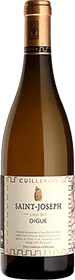
Yves Cuilleron : Lyséras 2024
Only 1 available
Pre-arrivals - Stock in France
Let's talk about this product!
A pairing in mind? A question about the vintage? Comparison with another product? Find the answers here...
Description
Characteristics and tasting tips for the Saint-Joseph "Lyséras" 2024 by Yves Cuilleron
Tasting notes
Colour
The wine shows a brilliant, luminous yellow colour, enhanced by delicate golden highlights.
Nose
Particularly expressive and complex, the aromatic bouquet opens with notes of ripe yellow fruits such as peach and apricot, freshened by hints of citrus evoking lemon zest, grapefruit and mandarin. Floral scents of honeysuckle and verbena intermingle with subtle honeyed, spicy and delicately woody nuances.
Palate
The palate offers a texture of great elegance, both lively and mineral. The rich, mouthwatering attack gives way to a pleasant freshness carried by vibrant acidity. The mid-palate confirms the intensity of the fruity aromas found on the nose, stretching towards a balanced finish of lovely persistence.
Food and wine pairing
This white wine pairs wonderfully with delicate fish such as cod en papillote with cherry tomatoes and verbena, roasted sea bass or seared scallops. It also enhances free-range chicken in cream sauce, delicately spiced Asian dishes, and pressed cheeses such as Beaufort or Comté.
Serving and cellaring
For optimal enjoyment, we recommend serving this Rhône Valley wine at a temperature of 12°C, opening the bottle half an hour before serving. This wine can be enjoyed in its youth but will continue to evolve favourably until around 2029.
The authentic expression of a great white wine from the Rhône Valley
The estate
Founded in 1920 by Claude Cuilleron, the family estate has established itself as a true benchmark in France. Today, Yves Cuilleron is at the helm of the property and manages a vast vineyard spread across the region's finest appellations. A fervent advocate of tailor-made viticulture, the current owner rejects conventional standards in favour of a pragmatic approach. His sole philosophy is to produce the best possible grapes in order to reveal the purest expression of each terroir.
The vineyard
The grapes for this cuvée come from the northern part of the Saint-Joseph appellation, in the communes of Chavanay and Saint-Pierre-de-Bœuf. The vines, planted at high density on steep terraces, benefit from an ideal south and south-east exposure. They thrive on predominantly granitic soils interspersed with sandy elements. Because of the topography, most of the vineyard work is carried out by hand. The estate favours natural grass cover to limit erosion and uses no insecticides, thereby preserving local biodiversity.
Winemaking and ageing
After hand harvesting and rigorous sorting, fermentation starts spontaneously thanks to indigenous yeasts. Half of this white Saint-Joseph wine is vinified and aged in large oak foudres, while the other half rests in Burgundy-style barriques. Ageing lasts nine months, without any racking, on fine lees with regular lees stirring. Malolactic fermentation takes place in oak, bringing complexity and roundness, followed by a light filtration prior to bottling.
Grape varieties
Marsanne (50%), Roussanne (50%)