Located in the north of Scotland, Glenmorangie has been renowned for nearly 180 years
Located in the north of Scotland, Glenmorangie has been renowned for nearly 180 years for its whiskies, whose quality reflects the philosophy of excellence and precision of this exceptional distillery.
Location of the distillery
Founded 180 years ago, the Glenmorangie House is located on the banks of the Dornoch Firth, the northernmost estuary of the Scottish Highlands.
A centuries-old history
A House born in the 19th century from a shared passion
An iconic brand among the finest whisky references, Glenmorangie traces its origins to the town of Tain, in the north of Scotland. It was here, in 1843, that two enthusiasts, William Matheson and his wife Anne, acquired a former brewery housed in a building dating from 1738, and founded the distillery with the ambition of crafting exceptional Scottish bottles.
From the outset, a philosophy turned towards the future
Once the licence to distil had been obtained, malt production did not begin until late 1849.
Legend has it that William Matheson started distilling in two former stills previously dedicated to gin production. These two stills remain to this day the tallest in Scotland. As singular for their size as for their efficiency and innovative process, they made Glenmorangie a pioneer in crafting whiskies through prolonged contact with copper, lending an aromatic finesse that was entirely groundbreaking for the time.
A major boom with the arrival of the railway
An ideal location for crafting great whiskies thanks to its natural spring rich in minerals, Dornoch Firth also benefits from vast plains that allowed for the construction of a railway line to Tain. Although this railway was inaugurated in 1862, the year of William Matheson's death, the distillery quickly reaped the benefits of this progress. Thus, in 1872, it shipped 20,000 gallons of its whisky to a London warehouse and established a vast network of representatives, not only across the United Kingdom but also across the Atlantic. From 1889 onwards, the House began exporting its cuvées to the United States. They were sent directly in casks and bottled in San Francisco.
Early 20th century, a new chapter in history under the Macdonald family
It was in 1918 that the distillery was acquired by the Macdonald family, who had been the largest purchaser of the House's bottles in previous decades. Owned by the Macdonald family for 90 years, Glenmorangie experienced, like many other Scottish distilleries, a notable drop in production between the end of the First World War and the early 1950s, even having to close temporarily between 1931 and 1936, due to the strict prohibition and then the Great Depression in the USA, a country renowned for its high consumption of whisky.
1976 marked the revival of the House, whose growing production was henceforth dedicated exclusively to single malt whisky.
In order to expand production, numerous stills were installed within the distillery, namely two in 1976 and eight in 1990 within a specially dedicated three-storey warehouse. In 1997, the historic still became a museum. Wishing to perpetuate the pioneering spirit that defines Glenmorangie's signature, the Macdonald family began experimenting with new ageing processes in casks that had previously held other spirits such as cognac, Madeira wines and port.
Opening to the international market through the acquisition by the LVMH Group
In 2004, the Macdonald family sold Glenmorangie to LVMH, the French luxury group that aimed to develop the distillery's distribution potential through its extensive international network.
In order to establish the House as a benchmark among premium spirits, LVMH swiftly introduced new investments, such as the addition of four stills in 2008, bringing the total to 12, as well as a graphic redesign of the bottles and labels across the entire range.
A House with many distinctive features
Glenmorangie crafts Single Malt Whiskies of great quality, whose reputation is unanimously recognised both in the United Kingdom, where the House was for many years a market leader, and around the world.
To understand its signature is to discover the distinctive features and the expertise that make this distillery a major standard-bearer behind some of the finest spirits in the world.
An exceptional setting at the service of great spirits
The distillery's first distinctive feature lies in its water source, known as Tarlogie Springs. In order to protect this crystal-clear water rich in minerals, particular attention is paid to the preservation of the surrounding forest, which the distillery owns. This rare minerality gives each bottle a deliciously fruity aromatic palette, one of the hallmark elements of the Glenmorangie signature.
A warm and temperate climate
According to a Scottish saying, "Today's rain makes tomorrow's whisky". Despite its small size, Scotland surprises with its significant climatic variations from one region to another. The town of Tain enjoys a warm and temperate climate, marked by considerable rainfall.
High-quality barley at the origin of illustrious whiskies
The meticulous care given to each stage of the single malt production process is an integral part of the quality signature.
Rigorously selected, the malted barley then undergoes an initial fermentation that brings out the richness of the starch, followed by a complementary fermentation. Mainly made from malted barley aged in European or American oak casks, these spirits can also be crafted from local ingredients which, through their respective expression, are a subtle and refined reflection of these great terroirs of northern Scotland. Driven by a constant desire to explore new barley varieties, Glenmorangie has diversified its range, notably through editions based on Tùsail, a variety widely used in the past, as well as roasted chocolate malt (Signet Edition).
A pioneering distillery for over 180 years
Rich in a long history and bringing extreme rigour to every stage of the production of its whiskies, Glenmorangie has, over the generations, combined historic expertise with a pioneering vision resolutely turned towards the future.
Glenmorangie boasts the tallest stills in Scotland! This distinctive feature embodies the pioneering spirit of the distillery, its identity and its style. Indeed, the lightest and purest vapours reach the condenser, ensuring, through prolonged contact, the production of a particularly smooth and delicate alcohol that finely expresses every nuance of the malted barley.
16 people are in charge of crafting the Single Malt Whiskies. Known as "The Sixteen Men of Tain", this team ensures, in a perpetual quest for excellence, a prolonged process of distillation and fermentation followed by cooling after condensation, fostering the development of a unique aromatic expression for each yeast rigorously pre-selected.
The art of ageing
Across the generations, Glenmorangie has subtly combined traditional expertise with the use of innovative techniques. Extra Maturing, Wood Finishing (ageing in a container different from the original cask) and the selection of a single cask dedicated to each limited edition are all assets in making these bottles exceptional spirits.
Visionary, the House was the first to use former bourbon, port, Xérès and sherry casks to bring increased complexity during ageing. The distillery also owns a forest located in the Ozark Mountains, Missouri, in order to produce American white oak casks which, after a two-year period following their construction, are dedicated to ageing Jack Daniel's and Heaven Hill bottles for four years before returning to the House for the ageing of certain Single Malt Whiskies.
It has thus been able to refine its knowledge and expertise in managing ageing casks and so give rise to exceptional cuvées, each imbued with its own aromatic framework and finesse.
A collection of exceptional whiskies
Complex and of great elegance, the Glenmorangie style is the result of an alchemy between several factors: historic expertise, a relentless quest for excellence, crystal-clear water, a singular microclimate, and a particularly precise production process that champions meticulous distillation and prolonged maturation in high-quality oak casks.
A delicate and refined aromatic signature
Glenmorangie is renowned for the comprehensiveness of its range of Scottish whiskies, whose excellence reveals, through each cuvée, both the distillery's commitment to quality and the nuances of the great terroirs of the Highlands. Each Single Malt Whisky is the perfect illustration of the distillery's technical rigour, giving rise to spirits of rare richness and refinement.
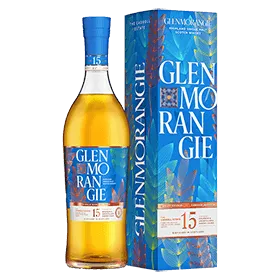
Cadboll Estate 15 Years Old, the quintessence of blending expertise
Produced as a limited edition, this spirit is crafted from two barley harvests from the Cadboll estate. A first batch is aged in American oak bourbon casks to develop its creamy texture. Aged in former Amontillado (sherry) casks, a second batch in limited quantities reveals delicious notes of hazelnut, caramel and clove. After 15 years of ageing, the blending of these two batches reveals a spirit that seduces with its delicious notes of hazelnut, caramel and spice (clove).
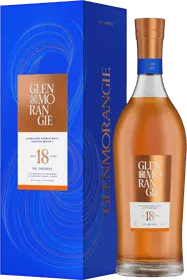
18 Years Old Extremely Rare, the suave complexity of prolonged ageing
A quality standard-bearer of the Glenmorangie range, this whisky combines a fruity aromatic framework with a silky structure.
Following 15 years of ageing in American white oak ex-bourbon casks, part of the production (30%) benefits from an additional 3 years of ageing in Oloroso sherry casks from Spain. After a total of 18 years of ageing, the final blend is composed, a delicate balance between optimal harmony and aromas of marmalade, honey, fig and caramelised orange. As the tasting unfolds, the vivacity imparted by the Oloroso casks harmoniously combines with the softness of the American oak.
Grand Vintage Malt 1997, one man's dream
Distilled in 1997, this Grand Vintage reflects the quest of Bill Lumsden, master distiller and Director of Whisky Creation at Glenmorangie, to develop, through the use of rare wine casks, an ever more comprehensive and expressive aromatic richness.
Thus, after 13 years of ageing in bourbon casks, part of the production undergoes additional ageing in Oloroso sherry casks but, above all, a small portion in casks from Château Montrose, a completely innovative process for the time. Bill Lumsden had managed to obtain a few barrels from this illustrious estate in Saint-Estèphe on the left bank of Bordeaux, the interior of each of which is marked by an intense colour that is echoed on the wooden case of this exceptional whisky. Citrus notes, aromatic depth, smoothness and finesse are its main characteristics.
Nectar Or, where indulgence meets precision
This whisky draws its inspiration from a universal memory: that of our first time entering a patisserie, that unique moment when the indulgent fragrances immediately awaken the desire to taste the creations displayed before us. Following 10 years of ageing in American bourbon casks, the blend is then transferred to French oak casks previously used for ageing sweet white Sauternes wines for two years of extra-maturation. This innovative process is rounded off by the decision, as a final touch, not to use cold filtration, in order to preserve the rich and unctuous texture of this whisky. Of rare complexity, the aromatic palette blends spicy flavours with indulgent patisserie aromas of lemon curd, crème caramel and almond croissants.
12 Years Old Palo Cortado Cask Finish, unctuousness enhanced by rare elegance
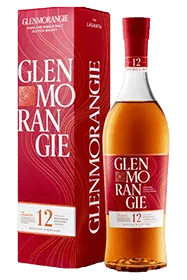
The name of this cuvée, as rare as it is refined, refers to Palo Cortado, an exceptional type of sherry obtained when the protective yeast, known as "flor", fails to develop on the wine originally intended to become an Amontillado. After 12 years of ageing in bourbon casks, this Single Malt Whisky benefits from an additional 4 years of maturation in Palo Cortado sherry casks, a white Xérès wine renowned for its sweet and hazelnut aromas.
The result of this innovative ageing process lives up to the distillery's pioneering philosophy. A spirit of seductive elegance, whose notes of black plum and hazelnut are underpinned by subtle aromas of milk chocolate, Brazil nuts and sweet spices.
Signet, the subtle alliance of power and vivacity
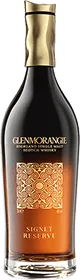
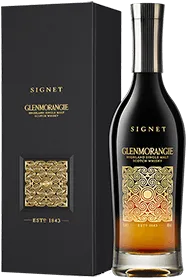
It was while tasting his favourite Jamaican coffee, Blue Mountain, that Bill Lumsden, master distiller of Glenmorangie, inspired the creation of a spirit that magnifies the richness and indulgence of mocha.
Many years of work were required to create the Signet cuvée, crafted from both heavily roasted barley and barley from the Cadboll estate, in order to produce a chocolate malt alcohol, made only once a year in the House's stills. The final blend combines smooth whiskies extra-matured in former sherry casks, spicy and toasted whiskies from charred new oak casks, as well as a portion of the production from whiskies drawn from the distillery's historic stocks.
Tasting this singular bottle is a unique moment in which notes of tiramisu, melting chocolate, bitter mocha, spices, dark chocolate and unctuous caramel combine with rare harmony.
A Tale Of Forest, a refined and expressive limited edition
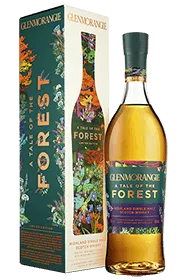
The first Glenmorangie whisky made from barley roasted with woodland plants, A Tale of Forest is crafted using an ancient method of roasting barley with plants such as juniper, birch bark and heather flowers. This spirit captivates with the richness of its aromatic palette, where woody notes of pine and juniper blend with floral touches of eucalyptus and aromas of coriander and bitter orange. Presented in an elegant gift box, this cuvée features a design by Thai illustrator Pomme Chan.